

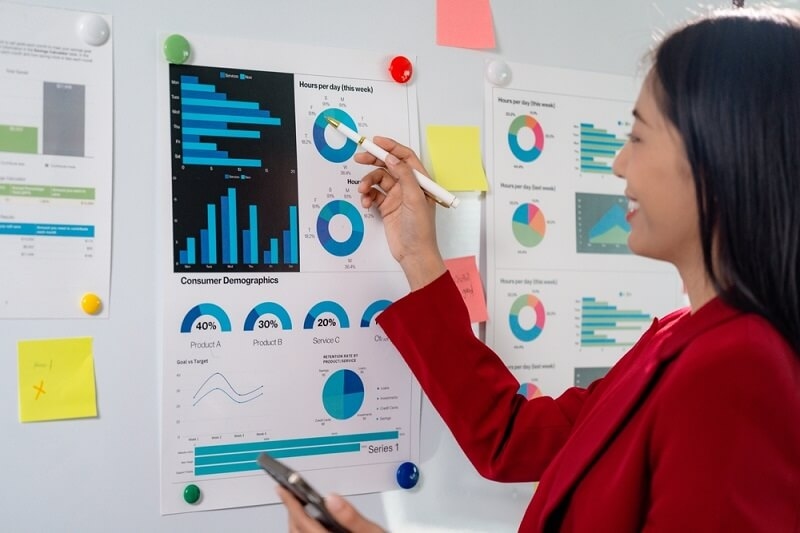
Marketing was a guessing game of sorts. You peeped at previous trends, followed your hunch, and wished you had taken the proper coat. Today, the guessing game has evolved. Combined with AI, predictive analytics can now assist the marketer in predicting what the customers desire, when they desire it, and how they desire to learn it.
This transformation is not only technical. It alters the decision-making process, spending of the budgets, and the way brands communicate to individuals in a manner that is not obnoxious but timely. This paper will take us through the process of how predictive analytics marketing informs AI decision-making, why this is important to real businesses in the US, and where human judgment continues to be a silent but important factor.
The future of the modern AI-driven campaigns is predictive analytics marketing. The humming of the engine under the dashboard is what bends the next.
This method, at its heart, relies on historical data, current indications, and probability to provide suggestions on how the future may perform. Not blind predictions, but schooled forecasts. Crystal ball, less so; weather radar, more.
Marketers love instincts. They also love stories about instincts. But AI does not care about either.
Predictive systems scan thousands of past interactions and notice patterns humans would miss on a busy Monday morning. Did customers click emails more often on rainy days? Did conversions spike after paycheck Fridays? These signals add up.
That is where predictive analytics marketing shines. It removes some emotion from decision-making while keeping results grounded in reality.
Old-school analytics told you what happened. AI-powered systems suggest what to do next.
Instead of a static report, marketers now see recommendations like adjust timing, tweak messaging, or pause a campaign. It feels less like reading a spreadsheet and more like having a quiet strategist in the room.

AI marketing insights are not abstract ideas floating in the cloud. They shape everyday decisions that affect revenue, customer trust, and brand tone.
Here’s the thing. AI does not decide goals. People do. AI helps choose paths.
Most AI systems rely on decision trees and models that adjust with new data. When a campaign works, the system learns. When it falls flat, it learns faster.
This learning loop helps marketers avoid repeating mistakes. It also explains why AI recommendations feel sharper over time.
This part surprises people. Sometimes AI advises against action.
A model might suggest holding off on a promotion because customers show fatigue. That pause can protect long-term loyalty. Honestly, restraint can be a powerful strategy.
Forecasting customer behavior sounds fancy, but the goal is simple. Understand what people are likely to do next.
Not what they say they will do. What their behavior hints at.
Browsing time, abandoned carts, email opens, and even scrolling speed offer clues. Individually, they mean little. Together, they tell a story.
Predictive systems read these signals like a seasoned cashier reading a line of shoppers. Who is ready to buy? Who is just browsing?
In the US market, timing matters. Back-to-school season, holiday shopping, tax refunds, summer travel. AI models factor in these rhythms.
You know what? Humans feel these seasons, too. AI just remembers them better.
Marketing intelligence tools are the translators between raw data and human understanding. They turn chaos into something usable.
These platforms collect data from CRMs, ad platforms, websites, and social media, then feed it into predictive engines.
Platforms like Salesforce, HubSpot, Adobe Analytics, and Google Analytics often sit at the center of this ecosystem. Add tools like Tableau or Looker for visualization, and suddenly, insights feel tangible.
The magic is not the tool itself. It is how the data connects across channels.
Here’s a mild contradiction. Data-driven does not mean data-only.
Smart teams question outputs, test assumptions, and double-check recommendations. AI suggests. Humans decide.
Predictive modeling sounds technical, but it shows up in simple ways across campaigns.
Email subject lines, ad placement, discount timing. All of it can be shaped by predictive scores.
Sales teams love predictive lead scoring. Instead of chasing every lead, they focus on the ones most likely to convert.
That focus reduces burnout and improves close rates. A rare win-win.
Predictive models can suggest which content to show and when. A first-time visitor might see educational content. A repeat buyer might see a loyalty offer.
It feels personal, not pushy. That balance matters.
Campaign planning used to involve whiteboards, sticky notes, and crossed fingers. Today, predictive analytics adds a safety net.
Not a guarantee. A guide.
Predictive insights help teams allocate budgets based on expected returns. Channels with stronger signals get more attention.
When budgets tighten, this clarity becomes essential, not optional.
AI-driven planning supports controlled experiments. Marketers can test variations while minimizing risk.
Let me explain. Instead of guessing which idea might work, teams test several, learn quickly, and adjust calmly.
Despite all the math, marketing remains human. Emotions, context, and ethics still matter.
AI does not understand brand values. People do.
Predictive systems raise questions about privacy and transparency. Customers notice when personalization feels creepy instead of helpful.
Smart brands set boundaries. They decide what not to predict.
Sometimes a marketer ignores AI advice. A cultural moment, a brand shift, or a gut feeling calls for it.
That choice is not a failure. It is judgment.
Predictive analytics marketing has reshaped how AI decisions happen in modern marketing. From forecasting customer behavior to guiding campaign planning, these systems help teams act with clarity instead of guesswork. Yet the most effective strategies blend machine insight with human awareness. AI reads patterns. People read the room. When those strengths work together, marketing feels less mechanical and more meaningful.
It takes historical and up-to-date information in order to predict the behavior of the customers. This assists the marketers in being more confident about making decisions in their next moves.
They assist in prioritizing and cutting down on wasted expenditure and concentrating on customers, who are most likely to react despite the meager resources.
There are numerous tools that are not technical. Insights become simple to interpret and take action with the help of dashboards and visuals.
No. Predictive models make decisions, but human invention, morals, and judgment are vital to effective marketing.
This content was created by AI